Numbers That Matter: Mastering the Handicap Index and What It Reveals About Your Game
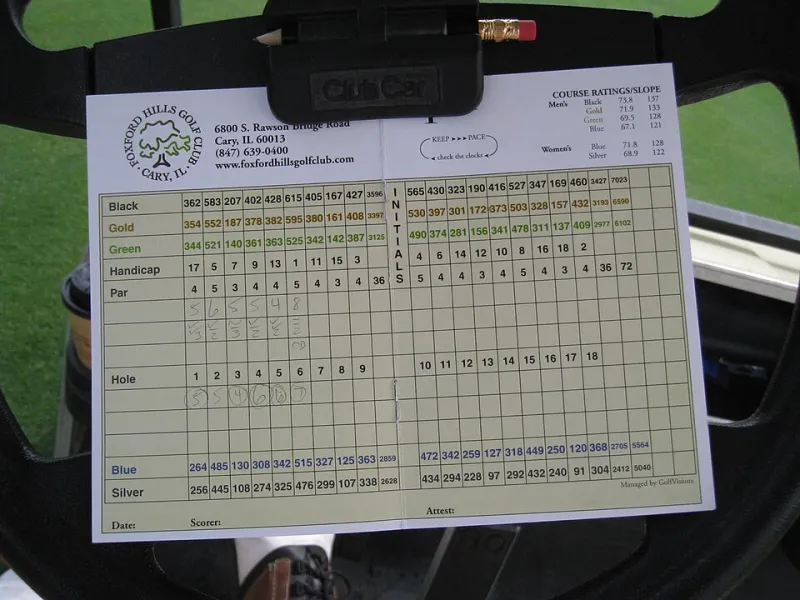
Photo: Dan Perry, CC BY 2.0, via Wikimedia Commons
There is a particular satisfaction in watching a well-matched foursome finish eighteen holes with the outcome genuinely in doubt until the final putt drops. That quality of competition — where a 6-handicapper and a 22-handicapper can stand on the first tee as legitimate rivals — is not accidental. It is the product of a system refined over more than a century, and at Greer Country Club, it is treated with the seriousness it deserves.
For members who have spent years chasing lower scores, the handicap index represents something deeply personal. It is, in many respects, the most honest measure a golfer possesses — a rolling average that neither flatters nor forgives, updated with each posted round.
A Brief History of Equitable Play
The concept of equalizing competition between golfers of differing abilities dates to the late nineteenth century in Scotland, where informal stroke allowances were first negotiated among playing partners. The United States Golf Association introduced its own handicap system in 1911, and for decades, various regional and national bodies operated parallel frameworks that created well-documented inconsistencies.
The most consequential development of the modern era arrived in 2020 with the global adoption of the World Handicap System — a unified standard endorsed by the USGA and The R&A that brought conformity to handicapping across more than one hundred countries. The WHS calculates a player's handicap index using the best eight of the most recent twenty score differentials, each adjusted for course rating and slope. The result is a portable, internationally recognized measure of a golfer's demonstrated ability.
"The World Handicap System was a genuine leap forward," says Greer Country Club's Head Professional, Daniel Whitfield. "Prior to unification, a member who played regularly at clubs in different states could carry slightly different indexes depending on which system governed each facility. Now, the number means the same thing everywhere. That matters enormously for serious competition."
What the Index Actually Measures
A common misconception among casual players is that a handicap index reflects average performance. In fact, it is designed to reflect potential — specifically, the level a golfer is capable of achieving on a good day under normal conditions. This distinction is critical.
Because the system draws on a player's best recent differentials rather than all posted scores, it creates a natural incentive: play consistently well, and the index falls. Play inconsistently, and it stabilizes at a level that reflects your ceiling rather than your floor.
At Greer, the club's Competition Committee monitors posted scores throughout the season, and members who demonstrate sustained improvement are recognized at the club's annual awards dinner. Member Edward Harrington, who reduced his index from 18.4 to 11.7 over the course of three years, credits a disciplined approach to data review as central to his progress.
"I started treating every posted score as information rather than just a result," Harrington explains. "When I saw that my worst differentials were almost always coming from the same three holes, I stopped accepting that as bad luck and started working with Daniel on specific strategies for those situations. The index gave me a map."
The Role of Course Rating and Slope
Understanding how a handicap index translates into a course handicap — the actual strokes a player receives at a specific facility — requires familiarity with two values assigned to every set of tees by the USGA: the course rating and the slope rating.
The course rating represents the expected score for a scratch golfer under normal conditions. The slope rating, ranging from 55 to 155 with 113 as the baseline, measures the relative difficulty of a course for a bogey golfer compared to a scratch golfer. The steeper the slope, the more strokes a higher-handicapper receives when playing that layout.
Greer Country Club's championship tees carry a slope of 138, a figure that reflects the genuine demands of the course. When members travel to play at other facilities, they carry their index with them and calculate their course handicap accordingly — a practical demonstration of the system's elegance.
"I always encourage members to understand the math, not just accept the number," says Whitfield. "When you know why you're receiving fourteen strokes at one course and eleven at another, you understand the game at a deeper level. That understanding tends to produce better decision-making on the course itself."
Practical Strategies for Index Improvement
For members committed to lowering their handicap, Whitfield and the club's teaching staff recommend a structured approach that goes beyond simply playing more rounds.
Post every score. The integrity of the system depends on accurate, complete data. Members who selectively post only strong rounds compromise their own competitive standing and undermine the equity the handicap system is designed to provide. At Greer, posting is a matter of club culture as much as USGA policy.
Analyze differentials systematically. Rather than reviewing only total scores, members benefit from identifying which rounds produced the strongest differentials and what conditions or preparation preceded them. Patterns invariably emerge.
Focus on limiting disasters. Statistical analysis consistently shows that handicap reduction is driven more by eliminating high-scoring holes than by adding birdies. A double bogey on a par four contributes more damage to a differential than a bogey on a par five. Managing risk — knowing when to lay up, when to take the conservative line — produces measurable results over time.
Engage with the teaching staff before the season begins. Greer's instructors offer pre-season index consultations in which they review a member's scoring patterns and build a practice plan calibrated to the areas most likely to produce differential improvement.
Competition as the True Test
Ultimately, the handicap index exists in service of competition — and at Greer Country Club, competition is the engine of the entire golf program. From the Men's and Ladies' Club Championships to the Invitational Series and the Greer Cup Matches, every event depends on the reliability of posted indexes to ensure that outcomes reflect skill, preparation, and performance rather than structural advantage.
For members who approach the game seriously, there is no more honest self-assessment available than the index printed beside their name on the club's competition board. It is a number earned through accumulated effort, and at Greer, it is respected accordingly.
"Every member who walks onto this course has a story behind their index," Whitfield reflects. "Some of those numbers represent decades of dedication. Others represent a player who has just begun to understand what they're capable of. Either way, the system honors that story. That's what makes it worth taking seriously."