The Quiet Craftsman: Twelve Hours With the Man Who Tends Greer's Grounds
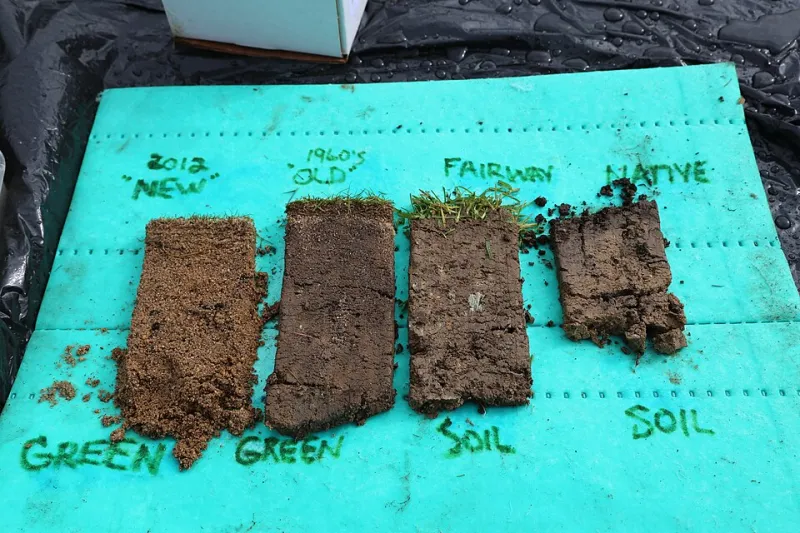
Photo: U.S. Army Corps of Engineers Europe District from Wiesbaden, Germany, Public domain, via Wikimedia Commons
The lights of the maintenance facility come on at 4:30 a.m., a full hour before the first member's car turns into the lot. By then, Greer's head groundskeeper has already been at his desk, reviewing overnight weather data, soil moisture readings, and the day's schedule with the settled calm of a man who has done this for more than twenty-five years.
"People think we grow grass," he says, pulling on his boots. "We don't. We grow roots. The grass is just what shows."
The Pre-Dawn Round
His first circuit is made in the dark, by utility vehicle, checking irrigation heads that ran overnight. A single misaligned head can drown one section of green and starve another. He walks the putting surfaces with a flashlight in hand, feeling for dew patterns that reveal drainage problems invisible in daylight.
By 6:15, the mowing crews are out — greens first, cut at heights measured in millimeters, each pass walked in alternating directions to train the grain. The precision is not vanity. "A member never remembers the fourteen good greens," he notes. "He remembers the one that was off."
Science in Service of Play
The superintendent's office looks more like a laboratory than a shed: tissue samples, moisture meters, a whiteboard dense with agronomic notation. Decisions about aeration, topdressing, and fertilization are made weeks in advance and communicated to the golf shop, so members are never surprised by maintenance on a Saturday.
He speaks of the job as a negotiation with the weather, the soil, and — not least — the membership's expectations. Fast greens are beautiful until they're unfair; soft greens are forgiving until they're slow. His art lies in holding the line between the two, season after season.
Afternoon Staging and the Long View
By mid-afternoon, the focus shifts from precision to presentation: bunker edges crisp, tee markers aligned, ball washers filled, the practice green staged for the next morning's lessons. He walks the course again — his third time around — seeing it this time as a member will, at eye level, club in hand.
What does he wish more members understood? "That the course is a living thing. Some days it needs rest the way you do. And that the best compliment we get isn't 'great conditions.' It's silence — when nobody notices, because everything just worked."
The Craft Behind the Curtain
Greer's grounds crew numbers a dozen full-time professionals, several with decades of tenure and one, the superintendent's protégé, now studying turf science at a state university on a club-sponsored program. Continuity, he believes, is the real secret to consistent conditions.
"Any crew can make a course good for a week," he says, watching the sun drop behind the eighteenth green. "The work is making it good for the next fifty years. That's the job. That was always the job."
The next morning, he will be back at 4:30. The greens, as always, will be ready.