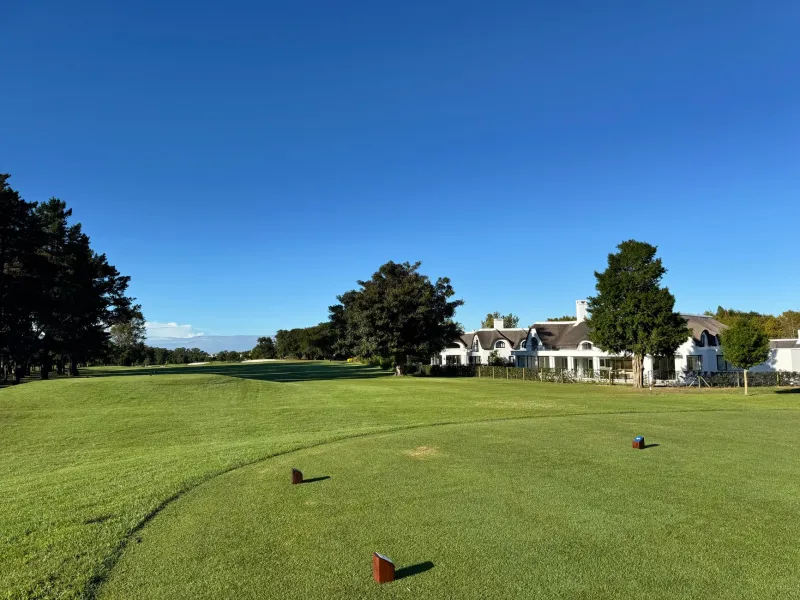
The Ground Between the Game: How Greer's Design Cultivates a Life of Deeper Reflection
Photo: Unknown, Public domain, via Wikimedia Commons
A country club, properly conceived, is not merely a facility. It is an environment — one shaped by intention at every scale, from the sweep of the fairways to the precise placement of a garden bench in a sheltered courtyard. At Greer Country Club, this understanding has informed every significant design decision since the property's earliest development, and it is most evident not in the celebrated features of the course itself, but in the quieter spaces that surround them.
These are the spaces between the game. And for many of Greer's most thoughtful members, they are the spaces in which the club's deepest value resides.
Architecture as an Invitation
The design philosophy at Greer proceeds from a conviction that physical environment shapes mental experience in ways both immediate and lasting. This conviction is not novel — it has informed the architecture of great institutions, from university quadrangles to the contemplative gardens of the nation's finest private estates — but it is applied at Greer with a consistency and intentionality that distinguishes the property from clubs that treat non-playing spaces as afterthoughts.
The pathways that connect the clubhouse to the practice facilities, the dining terrace to the member lounge, the first tee to the pro shop — these are not merely functional corridors. They are designed as transitional spaces, calibrated to slow the pace of movement and invite a different quality of attention. The plantings along these routes change with the seasons, offering a reliable marker of time's passage that busy professionals rarely encounter in the constructed environments of modern commercial life.
To walk these paths with genuine attention is to be reminded that Greer operates on a different clock than the one that governs most of a member's week.
The Deliberate Garden
Among the most carefully considered elements of Greer's grounds are the garden spaces positioned at intervals throughout the property. These are not decorative gestures. Each garden has been sited and planted with an awareness of the visual and acoustic conditions it creates — the degree of enclosure it offers, the quality of light it admits at different hours, the degree to which it separates a visitor from the ambient activity of the club.
The result is a series of distinct sanctuary environments, each suited to a different mode of reflection. The more open garden adjacent to the east terrace invites the kind of relaxed, ambient thinking that benefits from visual breadth — the slow accumulation of perspective that comes from looking outward across a well-ordered landscape. The more enclosed courtyard near the member entrance offers something different: a genuine sense of removal from the surrounding environment, a space in which focused thought becomes natural rather than effortful.
Members who have discovered these spaces as habitual stopping points speak of them with a particular affection — not as scenic amenities, but as reliable conditions for clarity.
Where Decisions Actually Happen
It is a well-documented phenomenon in organizational psychology that the most consequential decisions are rarely made at the moment of formal deliberation. The board meeting ratifies what the quiet walk home from the office began to resolve. The business lunch confirms a conclusion that formed during an unhurried breakfast. The setting matters, and settings that encourage genuine reflection — rather than performance or distraction — produce better outcomes.
Greer's membership includes a substantial concentration of professionals whose decisions carry significant weight: executives, attorneys, physicians, investors, and civic leaders who carry the demands of their responsibilities into every environment they enter. The club has long understood that serving this membership means providing not only excellent golf and dining, but also the physical conditions in which genuine mental decompression becomes possible.
The alcoves, gardens, and quiet passages of the property serve this purpose directly. They are, in the most practical sense, tools for better thinking — and the members who use them with intentionality tend to be the ones who describe their Greer membership in the most expansive terms.
The Porch and the Passage
Two features of Greer's design merit particular attention for their contribution to reflective experience. The first is the covered porch that extends along the western face of the clubhouse, oriented to receive the late afternoon light that characterizes the property's most beautiful hours. This space — furnished simply, shaded generously, and positioned to overlook a portion of the course without dominating it — has become one of the club's most quietly beloved gathering points.
Conversations on this porch have a different character than those inside the dining room or on the practice green. The combination of partial enclosure, outdoor air, and the unhurried quality of the light seems to invite a different register of exchange — more reflective, more candid, more willing to move past the transactional and toward the substantive.
The second feature is the stone passage that connects the lower parking area to the main clubhouse entrance. It is a brief walk — no more than two or three minutes — but it has been designed as a genuine threshold experience. The transition from the noise and pace of the outside world to the composed environment of Greer is made tangible by this passage, and members who traverse it regularly describe a reliable psychological shift that occurs somewhere along its length.
Threshold design of this kind is rare in contemporary club architecture, and its presence at Greer reflects an understanding of member experience that extends well beyond the conventional.
The Practice of Pausing
Ultimately, the value of these spaces depends on the willingness of members to engage them with genuine intention. Greer cannot manufacture reflection — it can only provide the conditions in which reflection becomes natural. The member who moves through the property at the pace of his most pressured professional day will find beautiful surroundings. The member who allows the environment to slow him — who sits in the garden before the round, who walks the passage without checking his phone, who remains on the porch after his companions have departed — will find something considerably more valuable.
This is, in the end, what Greer's architects and stewards have always hoped to offer: not merely a place to play golf or share a meal, but a place to become, briefly and reliably, the more thoughtful version of oneself. The spaces between the game exist to make that possible. The rest is up to the member who walks through them.